Yoshihiro Saito speaks at JAME on the latest trends and future of music-generating AI
On September 9, 2026, Yoshihiro Saito, CEO of EXDREAM Inc., gave a talk at the Japan Association of Music Enterprises (JAME) titled “The Latest Trends and Future Outlook for Music-Generating AI.”
The presentation introduced leading music-generating AI services, their features, and the evolution of AI-powered music production environments. It explained the potential of AI in the music business and its impact on future production workflows, while also addressing rights and licensing, transparency around AI-generated content, and technologies for identifying its origin, offering a future outlook from both technological and practical perspectives.

Live demos of leading music-generating AI services
The talk covered and explained a broad range of music-generating AI services, including Suno, Udio, Mureka, Flux Context, and Gemini (Lyria). Using the same lyrics and genre, we compared differences in vocals, musical style, and lyrical expression, demonstrating the generation process and each service’s distinctive features through live demos.
AI-generated music: realities and challenges in the data
The presentation used Deezer’s published figures to distinguish the volume of music uploaded from how it is played and monetized.
- AI-generated tracks received per day
- ≈90,000 Deezer · July 2026 disclosure
- Share of new daily uploads at peak times
- >50% Deezer · July 2026 disclosure
- Streams of fully AI-generated tracks identified as fraudulent
- Up to 85% Deezer · streams in 2025
Scope: Deezer only, not the entire music market. Sources: July 2026 results (daily volume and upload share); April 2026 disclosure (fraudulent streams in 2025).
Drawing on the data, the talk explained the challenges of AI-generated music in today’s music streaming business, where a growing supply of tracks does not necessarily lead to equivalent growth in demand or revenue. It offers a perspective on creating new listening experiences and revenue opportunities beyond simply generating more tracks.
AI music generation is becoming part of music production environments
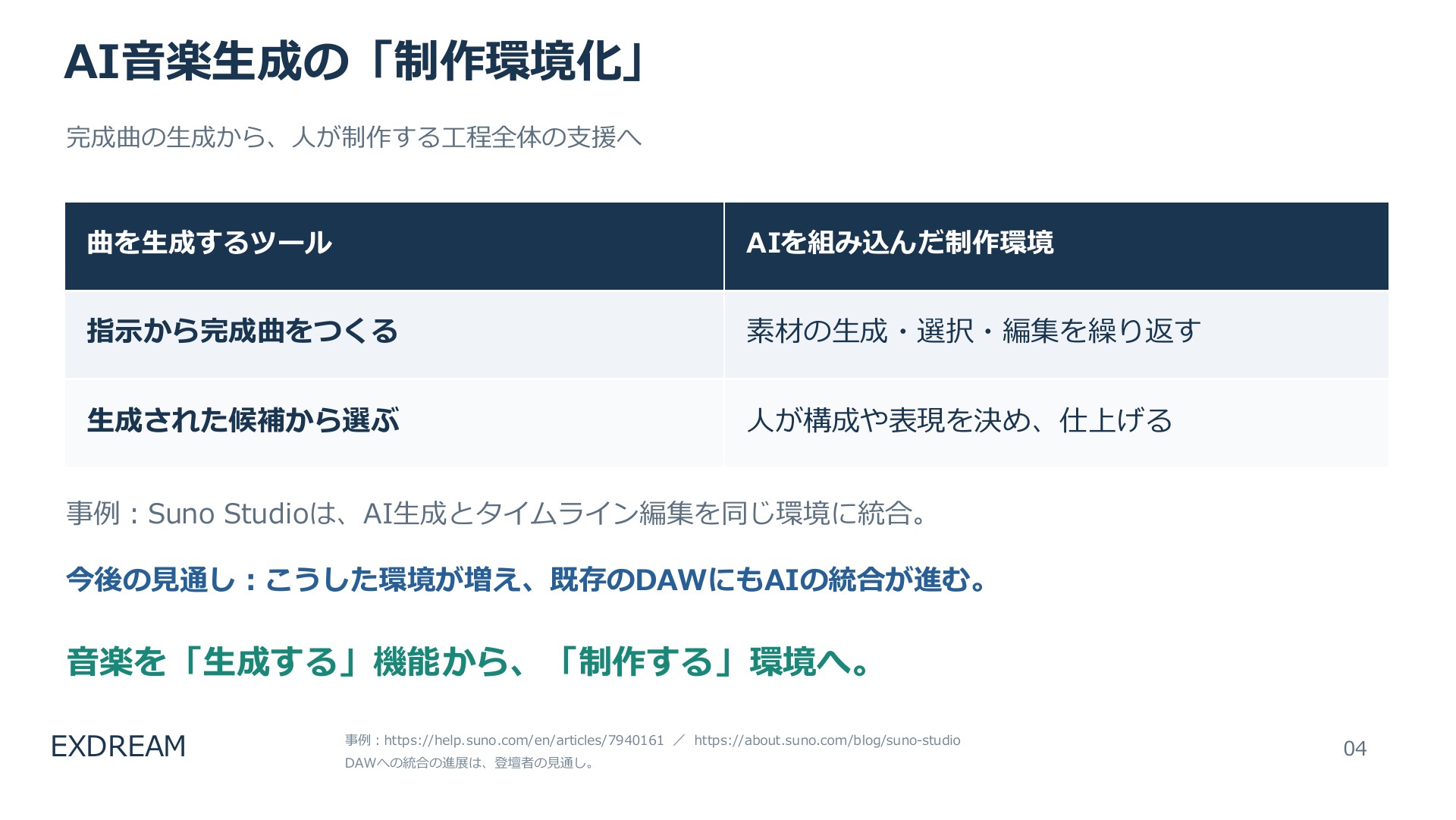
The talk explained the shift from choosing a finished AI-generated track to a production environment where people repeatedly generate, select, and edit material, deciding the structure and expression themselves. Suno Studio was introduced as an example of AI generation and timeline editing integrated into one environment. The speaker also shared an outlook for further AI integration into existing digital audio workstations (DAWs).
The AI era: where rights, business workflows, and technology intersect
Was the audio AI-generated, which service contributed to it, and which training data influenced the output? The talk clarified that detection, provenance information, and training-data attribution each address a different question. Identifying AI involvement and confirming permission to use a work or its rights status are treated as separate checks.
The presentation also outlined how AI and software could connect market and fan analysis, planning and talent discovery, music generation, rights and contract management, distribution, promotion, and revenue management. Beyond adopting individual generation tools, we also offer proposals for rethinking how AI and software can transform the business as a whole.
This report summarizes the September 9, 2026 presentation. Service examples and figures reflect the material presented at that time.